

by
 Joseph Freeman
| Updated Jun 30, 2026
Joseph Freeman
| Updated Jun 30, 2026
.jpg?width=1200&height=650&name=CC%20Hotel%20Marketing%20Strategies%20That%20Keep%20You%20Booked%20All%20Year%20(2).jpg)
September hits and the pattern starts again. The phones slow. The dining room has more empty tables than full ones. The tee sheet looks like Swiss cheese on weekdays, and you run the same math you've run every fall for the last five years.
The hotel marketing strategies that actually keep a property booked through the slow months aren't louder versions of what most resorts already do. They're a different kind of work: building demand you control before the calendar goes quiet, instead of chasing it after it already has. Peak season fills itself. The off-season has to be earned.
One luxury golf resort in Alabama used this approach to triple its shoulder-season group bookings in a year. The strategies below are the ones that got them there, laid out so you can start with the one that pays back fastest.
Why most hotel marketing strategies stall in the off-season
Most hotel marketing strategies stall off-season because they're reactive. The property waits for demand, and when peak-season demand stops arriving, there's no system to replace it. Discounts, OTA listings, and boosted posts plug a few gaps, but none of them build anything you can repeat next year.
The slow season itself isn't the problem. The way most resorts respond to it is. Discounting teaches guests to wait for the deal, so they stop booking October at full rate and hold out to see what shows up in November. Boosted social posts vanish in 48 hours and leave no contact, no relationship, and no way to follow up. And every fall the cycle resets, because nothing from last year's scramble carried over.
That reactive cycle is the real villain, and OTAs are one of its symptoms. When you have no system of your own, you lean on whoever brings the booking, and the OTA is happy to.
Here's the part worth getting right. OTAs earn their place as a first-booking channel. They put your property in front of travelers who are actively searching, and there's a well-documented pattern behind why that matters: Cornell's School of Hotel Administration found that roughly 75% of travelers who booked directly with a major brand had visited an OTA first . A lot of guests see you on the platform, open a new tab, and look you up before they decide.
The cost shows up when the OTA is your only channel and you stop at the first booking. Commissions for independent properties commonly run 15% to 30% per reservation Think about what delivery apps did to restaurants: they bring orders the kitchen wouldn't have gotten, take a cut off the top, and keep the customer, so the person who ordered never becomes a regular. OTAs do the same with your rooms. The platform keeps the guest's email, payment profile, and booking history, then markets to that guest again, usually beside two or three competing properties, before their next trip. Expedia Group alone reported about $23 billion in lodging gross bookings in a single quarter. That's an audience you can reach once and then keep, if you set things up to capture it.
GolfNow works differently from the commission OTAs. It trades on tee-time inventory rather than charging a cash commission, so the cost lands as discounted rounds you give up, not a line item on the invoice. Worth tracking the same way: what are you paying, and do you keep the golfer afterward.
None of this means dropping OTAs. It means not building your off-season on them. The strategies that follow are about creating demand you own, so the platform becomes one way new travelers find you instead of the whole engine.
Start with an audience you own
An owned audience is the list of people who've given you permission to stay in touch: past guests, event planners who toured the venue, golfers on your email list, couples who got married on the property three years ago. These people already know you. You don't have to convince them the resort is worth visiting. You have to stay in their world before they think to look elsewhere.
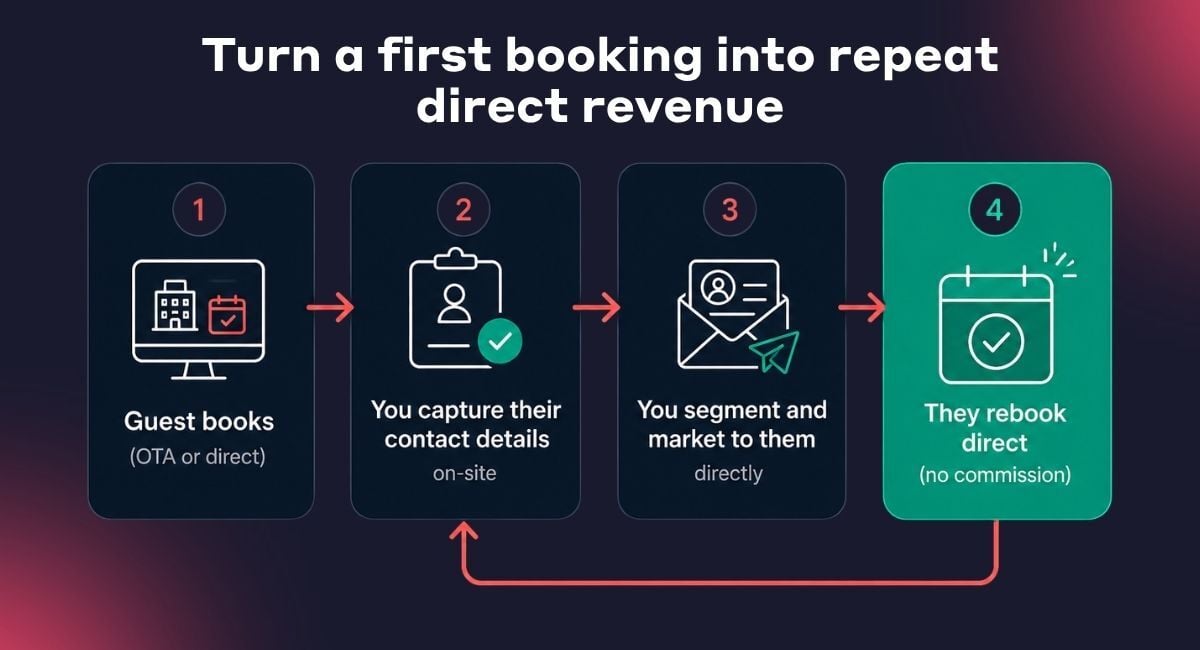
Building it comes down to three habits. Capture contact details while guests are on site, through a Wi-Fi sign-in that asks for a name and email, a QR code at check-in or in the room, or a quick ask at the front desk. A guest will trade an email for the resort password without a second thought, so collect the whole party where you can, not just the name on the reservation. Get every contact into one place, because a simple CRM beats a spreadsheet nobody updates. Then tag people by why they came: golf, weddings, corporate events, a weekend site at the park.
The payoff is the math. A guest you captured costs almost nothing to reach again. A guest the OTA captured costs you a commission every time they come back. Over a few visits, one owned relationship is worth far more than the booking that started it.
Email reactivation: the fastest off-season win
Email reactivation means contacting past guests and warm leads who've gone quiet and giving them a reason to come back. It's the fastest off-season win because the audience already knows you, so there's no cost to reach them and no trust to rebuild. A short sequence to past corporate clients in August, before Q1 planning starts, can refill weekday dates that would otherwise sit empty.
The mechanics are simple once the list is segmented. A golf group hears about a fall stay-and-play. A corporate planner hears about open weekday dates and a meeting package. A past wedding couple hears about an anniversary getaway. Two or three messages per segment, timed ahead of the booking window, do more than a dozen generic blasts. Remind them of the experience they had, show them what's happening at the property this season, and give them an offer they can only get by booking direct. Relevant beats frequent every time.
Package the shoulder season instead of discounting it
Discounting trains guests to wait for the deal and signals the property is worth less. Packaging does the opposite. "Stay three nights, get a private golf lesson and dinner for two" raises the value of a slow-month stay instead of cutting its price, and it attracts guests who spend more on site, treat the property better, and come back.
A discount says October is worth less. A package says the experience is worth more. The deal-hunter who books "20% off" found you on price and leaves on price. The guest who books the package wanted the stay, and they're the one who books a spa treatment, orders the $200 dinner, and returns next year. Build packages around each segment: a stay-and-play for golfers, a meeting-plus-activity bundle for corporate groups, a long-weekend escape for couples. You fill the same dates at a higher rate and attract a better guest while you do it.
.jpg?width=1200&height=650&name=CC%20Hotel%20Marketing%20Strategies%20That%20Keep%20You%20Booked%20All%20Year%20(1).jpg)
Paid advertising that works when demand is low
Off-season paid advertising works when it targets intent and your own audience, not cold reach. Retarget people who already visited your site, run search ads against travelers and planners actively looking for venues and getaways in your region, and feed your guest list into the ad platforms as a seed audience to find more people like your best customers.
Judge it by booked revenue, not clicks or impressions. A campaign that spends a few hundred dollars and books one corporate retreat has paid for itself many times over, and you'll only know that if the booking is tracked back to the ad. Search ads catch demand that already exists. Social ads and retargeting keep the property in front of people who've shown interest but haven't booked. The owned list ties it together: the same guests you email are the seed for the audiences you advertise to, so the channels reinforce each other instead of competing.
Content that keeps your property top of mind
Content marketing for a resort means publishing specific, useful posts that keep your property in front of past guests and prospects between visits. A guide to the best off-season weekends in your area, photos of the grounds after the first snowfall, a corporate-events page that answers the questions a planner actually asks. Each one gives someone a reason to think about you before they go searching.
This is not blogging for its own sake. Useful content earns search traffic from people looking for exactly what you offer, then feeds your email and social so the same piece works in three places. It compounds: the post you publish this fall keeps pulling in guests next fall, while a boosted social post is gone by Thursday. Done consistently, content is what keeps you top of mind during the months when a guest decides where to spend their next trip.
What these hotel marketing strategies looked like at Pursell Farms
Pursell Farms, a luxury golf resort in Sylacauga, Alabama, ran these strategies as one system and tripled its shoulder-season group bookings. The number of shoulder-season group bookings tripled. The revenue those shoulder-month bookings brought in rose 138% year over year. Corporate event revenue grew from $1M to $1.95M, and in 2026 corporate events outpaced weddings and golf for the first time.
The property was already well known for golf and weddings, but weekday dates in the shoulder months were harder to fill, and it wasn't yet top of mind as a corporate event destination. The growth didn't come from discounting. It came from four moves working together: promoting specific offers like a holiday package paired with a complimentary activity, building guides and resources that put the resort in front of corporate planners, nurturing early interest with email tailored to corporate events, and using advertising and email to stay in front of prospects until they were ready to book. Capture the demand you're already paying to acquire, stay in touch with it, and convert it into direct revenue you keep. That's the core of how Booking Doubler™ works for resorts.
.jpg?width=1200&height=650&name=How%20to%20Increase%20Your%20Hotel%20Revenue%20from%20OTA%20Bookings%20Blog%20Images%20(1).jpg)
Reactive vs. proactive: where to start before the next slow season
The difference between a resort that's busy in the off season and one that isn't comes down to timing. Proactive properties build demand in the peak season for the bookings they want in the slow season. They keep a list of past guests and warm prospects they talk to consistently, so when the slow months arrive the pipeline is already there. Reactive properties wait, then discount, then wait again. You don't have to become a marketer to make the shift. You need a system that runs in the background while you run the property.
If you're reading this in spring or summer, you have time to build it. If you're reading it in the fall, start with the moves that pay off fastest.
- Segment your guest database. Separate past guests by type, because a golf group doesn't care about your wedding package and a corporate planner doesn't care about your tee-time special. The right message to the right person is what gets a response.
- Build a re-engagement sequence. Every guest who hasn't heard from you in six months is a warm lead going cold. Two or three emails that remind them of their stay and show what's happening this season can reactivate bookings you'd written off.
- Package the slow months instead of discounting them. Trade "20% off" for a stay that bundles a reason to come, and you'll fill the same dates at a higher rate with a guest who's more likely to return.
Get the Shoulder Season Revenue Playbook
Capturing and rebooking guests is easier with a checklist in hand. The Shoulder Season Revenue Playbook lays out the exact plays resorts and hotels use to fill rooms, tee sheets, and event space when business is slow. Find out how to capture guest details on-site, which offers bring people back, and the campaigns that turn a quiet month into a booked one.
.jpg?width=1200&height=650&name=How%20to%20Increase%20Your%20Hotel%20Revenue%20from%20OTA%20Bookings%20Blog%20Images%20(3).jpg)
See what this could look like for your property
On a Game Plan Call, we'll map where your bookings come from, where revenue is leaking, and what a system to capture and rebook your guests would look like for your resort. You walk away with a plan you can use, whether or not we work together.