
by
 Joseph Freeman
| Updated Feb 17, 2026
Joseph Freeman
| Updated Feb 17, 2026
The 3 AM “Scaries” Every Business Leader Knows All Too Well
It's 3 AM. You’re wide awake…again...mind racing, and heart beating fast.
It's not the scary monster under your bed. It's the business monster in your head.
If you're a founder or CEO, you're thinking about how to scale your B2B beyond your founder-led growth approach so you can sell your company, get acquired, or IPO.
If you're a marketing leader, you're thinking about how you're going to double your leads when everything you're trying just isn't going fast enough.
If you're a sales leader, you're thinking about how you can get more of those deals to close faster so you can hit your monthly quota.
But, regardless of which leader you are...
You know the boot-strapped approach you've been using for your company's marketing and sales growth just isn't cutting it anymore.
The Hidden Truth: You're Playing a Growth Game You Were Never Taught to Win
Here's what nobody tells you about B2B growth…
…roughly 3% of your target market is actively buying right now.
That’s it!
The other 97% are tire kickers. Even though they're clicking your bottom-of-the-funnel ads and visiting your website, they're not ready to buy—at least, not yet.
You've built your marketing and sales to serve the 3% "in market" and almost nothing for the 97% "tire kickers."
Meanwhile, if you're a CEO, you've done a great job of tapping into your network to help brute force the sales effort. You've sold to everyone in your Vistage, EO, and YPO networks, and your starting to need more opportunity than you can drum up alone.
Your little black book is tapped out!
So, how are you going to scale your B2B beyond this rockstar sales person and founder-led sales approach?
What if you could change things systematically?
What if you could install a system that allowed you to:
- Train and scale a proper growth team rather than relying on a rockstar CEO or sales person forever?
- Double your qualified marketing leads and sales pipeline by systematically nurturing those 97% tire kickers to an actual qualification call?
- Boost your closed/won conversion rates by delivering the same, quality sales experience to every single prospect, every single time?
Surprise! Surprise! You can. And you will.
It's Time to Operationalize Your Growth
Did you know that companies using systematic approaches and tools report:
- 300% improvement in lead-to-opportunity conversion rates (webfx.com)
- 67% reduction in sales cycle length (brainstormclub.com)
- 208% improvement in sales and marketing alignment scores (brainstormclub.com)
More importantly, you'll be able to sleep better at night knowing that you're building a company that will last far beyond you and any "rockstar" talent you may be blessed to temporarily have on your team.
Introducing B2B SCALE®: The Framework that Transforms Founder-led Sales into an Operationalized Growth Machine
B2B SCALE® is the step-by-step framework B2Bs use to standardize and operationalize their marketing and sales functions.
This is what empowers you to scale your B2B.
Just as Gino Wickman’s EOS (Entrepreneurial Operating System) gave business leaders a framework to run their companies, B2B SCALE® is the framework to operationalize your B2B growth (marketing and sales).
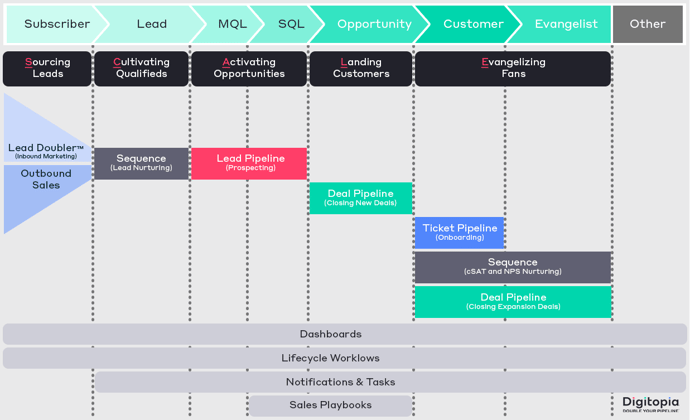
B2B SCALE® stands for:
- Sourcing Leads
- Cultivating Qualifides
- Activating Opportunities
- Landing Customers
- Evangelizing Fans
Unlike wild-wild-west marketing and sales tactics, B2B SCALE is a growth system.
Each phase builds on the previous one, creating a foundation that supports sustainable growth. It's designed specifically for B2B companies who need to operationalize their marketing and sales for scalability.
The B2B SCALE® Implementation Roadmap
Phase 1: Sourcing Leads
If you're reading this, you've probably experienced some great business success already that got you beyond $5M in annual revenue and potentially up to 8 figures. But you're not sure how to operationalize your marketing and sales to scale beyond where you are.
If that's true, continue…
- The Current Problem: You're casting wide nets with marketing that speaks to everyone and converts no one. Furthermore, you're relying on "rockstar" talent to make it all work.
- The Solution: Build a hyper-specific content funnel focused on one buyer persona and wrap it in automated nurturing and retargeting. This ensures your process is doing the heavy lifting, not your people.
Implementation Steps:
- Optimize a Single Page for Conversion: Yes, pick a single product or service you're selling and optimize it for conversion (you can repeat this whole proces for other product pages later). Don't skip this. Your current page is almost certainly not good enough.
- Rewrite it using the AIDCA formula ( Attention, Interest, Desire, Conviction, and Action).
- Ensure there's a prominent space in the template for both a Direct CTA ("Buy Now," "Schedule Call," etc.) and a Transitional CTA ("Download Guide," "Watch Webinar," etc.). These CTA names are borrowed from StoryBrand.
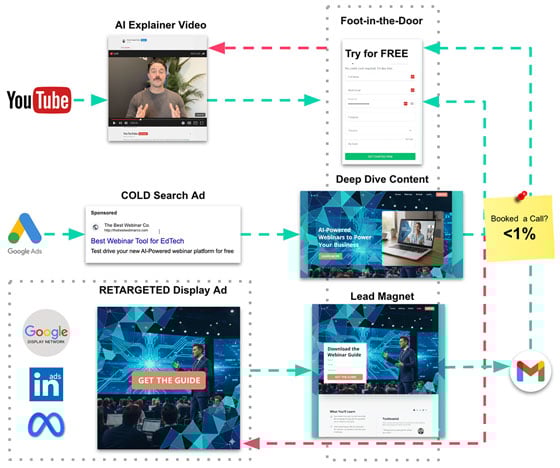
- Build the Foot-in-the-Door landing page: This is where you'll send users when they click the Direct CTA. It's your sales team's job to sell the product. But, the job of this page is just to sell the phone call. It should use the AIDCA formula to pitch the value of the call/demo/visit NOT the benefits of your product.
- Build the Lead Magnet landing page: This is where you'll send users when they click the Transitional CTA. It should offer an easy-to-say-yes-to download, tool, or webinar. The only field needed on the form to unlock it is a business email. You can use enrichment tools like HubSpot's Breeze, Apollo, or ZoomInfo to fill in the rest of the contact info behind the scenes.
- Create a 2m video ad: Make a "talking head" video speaking to the problem, what the user has likely tried but hasn't worked, and finally your solution. This doesn't have to be high quality. Your mobile phone camera is fine. Make sure the first 5 seconds are super "hooky" to grab their attention so they keep watching. Call out your target audience right in that hook (ie. "If you're a CTO looking to..."). Write your script using the AIDCA formula.
- Run paid media campaigns:
- Send cold traffic from Google Search to your product page. Almost 100% of them will bounce. But they'll be "pixeled" for retargeting. And now they know your brand name.
- Run programmatic retargeting and look-alike ads to your Lead Magnet landing page to get visitors to take the very first baby step toward solving their problem. Just an email. No "Let's Talk" pitch yet.
- Run YouTube Skippable In-Stream ads to your Foot-in-the-Door landing page. YouTube is the second largest search engine in the world. It attracts bottom-of-the-funnel searchers looking for answers to solve immediate problems, many of whom are "in market" to buy.
Do all this and you've just created a very surround-sound type nurturing campaign. It's not casting a wide net, but it's casting a targeted one. It's following prospects everywhere they go and keeping your brand top-of-mind. You appear much larger than you may be and you're reminding them they have a problem they still need fixing.
Expected Results: 30%+ landing page conversion rates, clear messaging that resonates with your ideal prospects, and a steady flow of targeted (good ideal customer profile match) leads entering your funnel.
If you need help bringing this first step to life, check out Digitopia's Lead Doubler™ System service.
Phase 2: Cultivating Qualifieds
If you implemented Phase 1 correctly, you should now be getting more quality leads in the pipeline.
If that's true, continue…
- The Current Problem: You've got "leads" in the database, but they're going cold before they ever "raise their hand" to talk so you can qualify them.
- The Solution: Build a 25+ touch point, 1-to-1, sales nurturing sequence.
Implementation Steps:
- Build an automated nurturing sequence: A sales sequence is an automated workflow that assigns follow up tasks to your sales development reps (SDRs) and sends personalized, automated, 1-to-1 emails. We use HubSpot Sales Pro for this. If you don't have it, consider getting it. On average it takes 18 intentional touches to get a prospect to take action or respond. To be safe, build in 25+ touches, the first one being the delivery of the offer they requested. Users get enrolled in the sales sequence when they enter their email on your Lead Magnet offer landing page and then your team gets assigned follow up tasks on dates relative to the day the filled out the form.
Expected Results: Leads start to warm up and start replying. This is what keeps them from going to die in your database and helps you identify them as marketing qualified leads (MQLs).
Phase 3: Activating Opportunities
If you implemented Phase 2 correctly, you should now be warming up and identifying leads that may be open to a sales qualification call.
If that's true, continue…
- The Problem: You need a way to systematically work your MQLs to an actual qualification call with an AE (account executive).
- The Solution: Build a lead pipeline supported with a playbook.
Implementation Steps:
- Lead Pipeline: This looks similar to but is separate from your "deals" pipeline. It allows you to work leads systematically through the lead statuses leading to an actual qualification call. These leads should be assigned to the SDR.
- Recommended stages:
- New - The Lead Object has just been created.
No outreach has occurred yet. - Working (SAL) - SDR has begun outreach (calls, emails, sequence enrollment). Lead is in active pursuit but has not yet responded.
- Engaged - Lead has responded, clicked, or shown interest.Two-way interaction may have begun but no meeting is scheduled yet.
- Connect Booked - The Lead has an upcoming Connect/ Qualifying call scheduled. This is the official trigger for SAL (Sales Accepted Lead).
- No Show / Rescheduled - The Lead did not attend the scheduled meeting OR the meeting must be rescheduled. AE (your closer) determines next step: reschedule, recycle, or disqualify.
- Good Fit Bad Timing (SQL) - AE has conducted the Connect Call.
- BANT Qualified (Opportunity) - Full BANT (including timing) is confirmed AND a Discovery call is scheduled. This is the trigger for Deal creation + Opportunity lifecycle movement.
- Disqualified - Lead is not a fit based on criteria such as industry, role, budget, or other permanent disqualification indicators.
- New - The Lead Object has just been created.
- Connect Call Playbook: Create a standardized agenda for each qualification call and include the exact questions you need to ask every time. Also include optional questions depending on which way the call goes. If you build this in HubSpot you can also require certain information be collected before the filled-out playbook can be saved and stored with the lead record.
Expected Results: Leads have a systematic way to move from MQL to SQL (sales qualified lead) to an Opportunity lifecycle stage.
Phase 4: Landing Customers
If you implemented Phase 3 correctly, you should now be generating more qualification call appointments.
If that's true, continue…
- The Problem: Sales team improvises conversations (requiring rockstars) instead of delivering consistent, measurable sales experiences (not requiring rockstars).
- The Solution: Build a "deals" pipeline supported with a playbook.
Implementation Steps:
- Deal Pipeline (Opportunities): This is where your AE tracks actual deals (with revenue assigned) through your defined sales stages. Having this pipeline is what allows you to forecast and measure your pipeline coverage ratio, which the previous steps should be helping to keep at a healthy 3:1 (three times deals you're expecting to close at all times).
- Recommended stages:
- Discovery Call Booked - The Lead has an upcoming Discovery/Scoping call scheduled.
- Discovery Call Completed - Discovery call was completed and proposal is now being generated.
- Scope Complete - Proposal is complete and read to send/present.
- Presentation Booked/Sent - A presentation date has been scheduled with the prospect (if appropriate), or it has been sent.
- Proposal Presented - Proposal has been delivered.
- Agreement Requested - The prospect has requested a contract to sign.
- Closed Won - Prospect has signed the contract.
- Decision Stalled - Prospect has communicated that the decision will be delayed.
- Closed Lost - Prospect confirmed they will not be moving forward with signing the contract or they go dark for more than 30 days.
- Disqualified - Prospect is no longer a good fit for our product/services. Yes, it happens this late in the gaem even after the most rigorous of qualification attempts.
- Scoping Call Playbook: Create a standardized agenda for each scoping call and include the exact questions you need to ask every time. Also include optional questions depending on which way the call goes. If you build this in HubSpot you can also require certain information be collected before the filled-out playbook can be saved and stored with the deal record.
Expected Results: Consistent sales conversations, improved close rates, and customer experiences that reinforce your brand value proposition.
Phase 5: Evangelizing Fans
If you implemented Phase 4 correctly, you should now be turning more of those appointments into closed/won customers!
If that's true, continue…
- The Problem: You made the first sale. But, you have no way to systematically prompt your customer to buy again.
IMPORTANT! This is almost certainly your biggest missed opportunity for revenue growth. - The Solution: Build a customer satisfaction monitoring system and create a systematic way for your team to identify and surface upsell and cross-sell revenue opportunities.
Implementation Steps:
- Build an Onboarding Pipeline: First impressions matter. Build something similar to a deal pipeline using defined stages but for the steps you need to properly onboard a client the same way every time. You may use an SOP for this already. But by building it into a pipeline tool with stages (we use HubSpot's Ticket Pipeline) you can attach validation, automation, and reporting to each step to ensure your client services team is delivering on your brand promises.
- Recommended stages:
- Onboarding Tasks Assigned - When a new onboarding ticket is created it automatically assigns essential tasks to the finance, sales, and customer success teams.
- Internal Handoff Completed - Sales has handed off to the client services team all relevant info collected during the sales process.
- Client Kickoff Complete - Client has met the service team and has begun receiving contracted service.
- 30-day Sales Checkin Completed - Sales rep has checked in with the client to make sure they're off to a good start with the service team.
- 90-day cSAT Call Completed - Client services lead (not the delivery team) conducted a cSAT call or sent a survey form.
- Agreement Requested - The prospect has requested a contract to sign.
- Onboarding Completed -This is the "closed" state of the ticket indicating onboarding has completed successfully.
- Build a cSAT automated sequence - Similar to the sales sequences used in previous stages, this is sequence that the new client gets enrolled in during onboarding. It assigns tasks and potentially sends out automated emails, cSAT surveys, and NPS forms on schedule. It's ideal if it has tasks assigned to the client services lead to manually follow up with calls and emails to ensure clients give regular and honest feedback. The job here is to sniff out any problems before they become irreparable. Believe it or not, most of the time when you proactively surface a problem and fix it, a new upsell or cross-sell opportunity presents itself!
- Deal Pipeline (Expansion): This is where your client services lead tracks expansion deals through your defined sales stages. This is very similar to your new deal pipeline, but paired down just a little since there's no new-client discovery to be done.
- Recommended stages:
- Qualifying the Need - Potential new need surfaced from client. Attempting to schedule DISCO (discovery) call.
- DISCO Call Scheduled - Discovery call is scheduled with client and client services lead.
- Planning & Scoping - Discovery call was completed and proposal is now being generated.
- Presentation Completed - Proposal has been delivered.
- Agreement Sent - The client has requested a contract to sign and it has been sent.
- Closed Won - Prospect has signed the contract.
- Closed Lost - Prospect confirmed they will not be moving forward with signing the contract or they go dark for more than 30 days.
- Scoping Call Playbook: Create a standardized agenda for each scoping call and include the exact questions you need to ask every time. Also include optional questions depending on which way the call goes. If you build this in HubSpot you can also require certain information be collected before the filled-out playbook can be saved and stored with the deal record.
Expected Results: You systematically seek out truthful feedback, get ahead of client dissatisfaction, and uncover more revenue opportunities in the form of upsells and cross-sells.
Why B2B SCALE® Works When Other Approaches Fail
Built for B2B Complexity
Unlike consumer marketing tactics, B2B SCALE® is designed specifically for B2B companies with complex sales cycles, multiple decision-makers, and high-value transactions.
Systems Over Tactics
While most marketing advice focuses on individual tactics, B2B SCALE® builds systematic operations that improve over time through optimization and automation.
Sales and Marketing Alignment
B2B SCALE® bridges the traditional gap between marketing and sales by creating shared metrics, a common language, and collaborative processes.
Proven Implementation Process
Rather than leaving you to figure out execution, B2B SCALE® provides step-by-step instructions, templates, and timelines for systematic implementation.
Implementation Prerequisites
Before beginning B2B SCALE® implementation, ensure you have:
- Marketing automation platform (HubSpot recommended)
- CRM system integrated with marketing automation
- Website with landing page creation capabilities
- Minimum $5,000/month paid advertising budget
- Dedicated team member for implementation (20+ hours/week)
- Executive sponsorship and sales team buy-in
Your Next Step: From Framework to Reality
The difference between founder-led sales and operationalized growth isn't talent, tools, or budget. It's having proven instructions for building systematic operations that allow you to scale.
B2B SCALE® provides those instructions. Not theory or philosophy, but step-by-step implementation guides with templates, timelines, and success metrics.
Want help implementing B2B SCALE® in your organization?
Book a discovery call today to see how the program will work for you.