
by
 Joseph Freeman
| Updated Mar 10, 2026
Joseph Freeman
| Updated Mar 10, 2026
Search Isn't Changing. It's Changed.
Search in 2026 does not look like search in 2016.
People are not just typing keywords into Google and clicking links anymore. They're asking full questions inside AI tools and getting complete answers in seconds.
Even Google searches are starting to look more like long-form generative engine prompts. Top-of-the-SERP Gemini-powered AI results are now pushing sponsored results, Google Business Profile listings, and finally, organic results down to the bottom of the page.
Many times searchers never click a website at all. They get their answer right on the search engine result page (SERP).
Tools like ChatGPT, Perplexity, Gemini, and other AI engines now summarize information, compare vendors, and recommend companies directly inside the response.
You know this already because you use generative engines every single day.
If your brand is not included in those summaries, you are not just ranking lower...
You are invisible.
AI Search Is Already Influencing Buyers
This shift is not theoretical. It's happening right now.
Buyers ask AI tools questions like:
- “Best FP&A software for mid-size SaaS companies”
- “Best HR software for 100–500 employee companies”
- “Top payroll and financial management platform for growing startups”
Instead of showing ten blue links, AI delivers a clean summary. It explains the options and often names specific companies.
Those names matter.
Those names should include YOURS.
If your company is not structured in a way AI understands, it will not mention you.
In fact, it probably doesn't.
Go use somebody else's ChatGPT or Perplexity (or whatever) and ask it something related to your company. Don't use your own account. It's trained by you and is biased.
Does your company come back in the AI recommendation?
No?
That means you're missing the chance to influence the buyer before they ever visit a website.
This is bigger than traditional SEO.
It includes Generative Engine Optimization (GEO).
It includes Answer Engine Optimization (AEO).
It includes structured data.
It includes authority signals.
It includes clear, consistent positioning.
AI engines reward content that is easy to understand and clearly organized. They prefer depth over fluff and proof over claims.
So, What Happens If You Ignore AI Search?
Let’s make this simple.
Imagine your company and another that offers the same service (yeah, I know yours is "better").
You both run ads.
You both publish blog posts.
You both have decent SEO.
But THEY have optimized for AI search. And you haven't.
When a buyer asks an AI tool for recommendations, only one company gets mentioned in the summary. Only one gets framed as the expert.
So, which company wins the meeting?
Not yours. Bummer.
AI search optimization is not about vanity traffic. It is about being part of the conversation that shapes decisions.
Even if you rank high in Google, AI may never mention you. That is because AI does not just scan for keywords.
Generative engines look for:
- context
- clarity
- authority, and
- consistency across the web
Many B2B companies are slowly losing influence without realizing it.
I'll repeat that in a different way...
Your company is slowly losing influence without realizing it.
Your traffic looks stable.
Your rankings look fine.
But your brand is NOT showing up in AI-generated answers.
Or maybe your traffic ISN'T stable.
Google rolled out AI Overviews on May 14, 2024.
Go look at your website session analytics right now. Does it look like this?
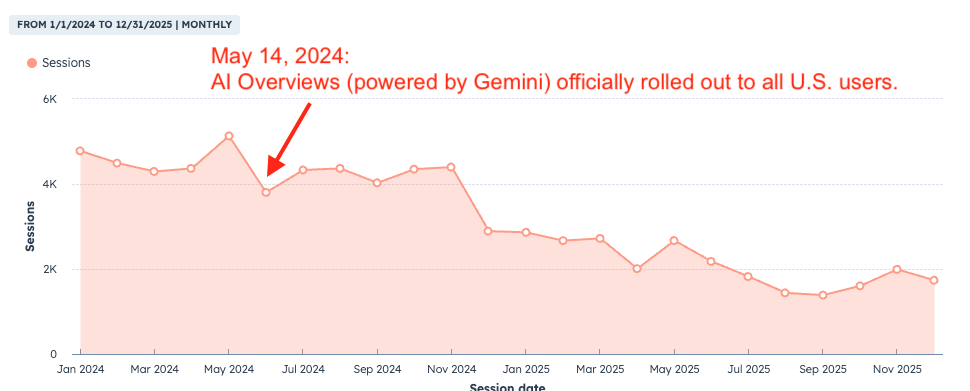
Many companies saw an initial dip in organic traffic in June 2004 and then began a steady decline until today.
That gap will only widen in 2026.
How do ChatGPT and Gemini
View Your Site?
Find out for FREE in just 4 minutes.
What Does It Really Mean to Optimize for AI Search?
Optimizing for AI search means building your site for how machines read, categorize, and trust information.
Here are the core pillars of optimizing for AI Search
1. Clear Positioning
AI must quickly understand who you serve and what you do. If your messaging is vague, it cannot categorize you correctly.
Do your homepage and service pages clearly state:
- Target audience
- Core problem
- Unique method
- Measurable outcomes
Specific beats clever. If your positioning is fuzzy, AI confidence drops.
2. Structured, Easy-to-Summarize Content
AI loves structure.
Do your homepage and service pages have:
- Clear heading
- Short section
- Logical flow
- Defined terms
- Step-by-step explanations
Long, rambling paragraphs without structure make it hard for AI to extract meaning.
Think like a teacher.
Explain ideas simply.
Break down processes clearly.
Remove unnecessary words.
When AI can easily summarize your page, it is more likely to reference it.
3. Deep Topical Authority
One blog post does not make you an expert.
Neither does two.
AI looks for patterns across your site. If you claim expertise in finances, HR, back office support (fill in the blank for your B2B) you need clusters of content that support that claim.
Do you have an authoritative collection of relevant:
- Educational blog posts
- Detailed guides
- Framework breakdowns
- Case studies
- FAQs
All of it should be connected through internal link to create a "web" of content.
Depth builds trust. Surface-level content signals surface-level expertise.
4. Strong Technical Foundation
Behind the scenes, technical signals matter.
Do you have your site code optimized? AI evaluates:
- Schema markup
- Clean HTML structure
- Page speed
- Crawlable content
- Logical internal linking
If your technical setup is messy, it reduces trust. AI engines rely on structured data to understand relationships between topics, services, and expertise.
Clean architecture supports clear categorization. Without it, even strong content can be overlooked.
5. External Authority Signals
AI does not only read your website. It scans external sources tied to you.
Are you on top of optimizing the following:
- High ratings on external review sites
- Frequent social mentions
- Guest articles on other authoritative sites
- Recognition in digital industry-related publications
If your brand appears consistently across trusted sources, AI confidence increases. If your footprint is small or inconsistent, you are less likely to be referenced.
Authority is not just self-declared. It is externally validated.
How To Get Started with AI Search Optimization
You do not need to rebuild everything tomorrow. But you do need to move intentionally. Here is a practical roadmap.
Send This Simple AI Visibility Checklist To Your Marketing Team Today
Step 1: Start With an AI Visibility Tool
- Run your site through an AI Visibility Tool to get an initial understanding of how generative engines are viewing you against your competitors
Step 2: Manually Test Your AI Visibility
- Go into the AI tools your target buyer likely uses and ask questions they would ask.
- Look for your brand in the answers.
- If you are not mentioned, document who is. That is your new benchmark.
Step 3: Tighten Your Core Messaging
- Review your homepage and service pages. Make sure they clearly answer:
- Who is this for?
- What exact problem do we solve?
- What makes our method different?
- What proof do we have?
- Remove vague statements.
- Replace them with clear, specific language. AI rewards clarity.
Step 4: Build Topic Clusters Around Core Service
- Choose your primary expertise areas and build depth around them.
- Create interconnected content that demonstrates experience and real-world results.
- Remember: Consistency compounds. Depth signals authority. Authority builds trust. Trust drives recommendations.
Step 5: Improve Technical Structure
- Work with your developer or SEO partner to ensure your site includes proper schema, clean structure, fast load times, and strong internal linking.
- Technical trust supports content trust. This creates more AI visibility.
The Big AI Search Optimization Picture
In 2026, search is no longer just about ranking.
It is about being referenced inside AI-generated answers that shape buying decisions before a prospect ever visits your site.
The brands that win will have clear positioning.
They'll have deep topical authority.
They'll have strong technical foundations.
They'll have consistent external validation.
They'll have structured, easy-to-understand content.
The brands that ignore this shift will slowly disappear from discovery, even if their traditional SEO looks stable.
Don't let your brand become invisible.
Search has evolved into more than a reulst—it's a conversation. Only trusted voices are quoted.
Make sure your brand is one of them.